
The Downside to Mushroom Coffee, From a Brand That Sells It
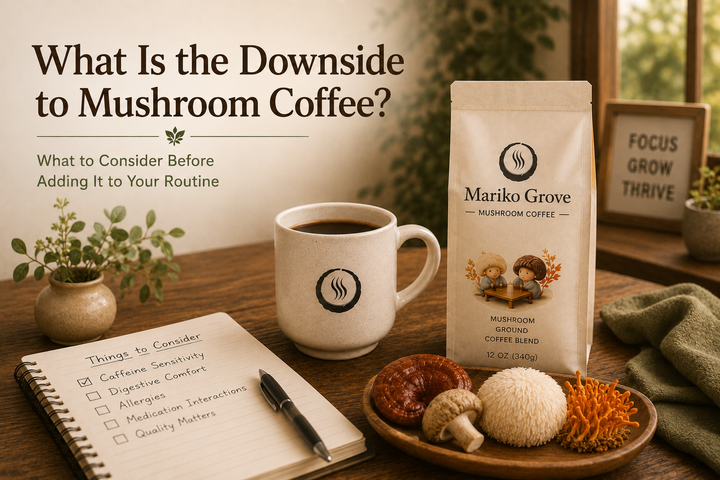
What Is the Downside to Mushroom Coffee? The Honest Answer
By Chris Rea, COO of Mariko Grove · August 2026
People ask us this more than almost anything else, and we'd rather answer it straight than dodge it. The downside to mushroom coffee comes down to two ordinary things: real caffeine, and functional mushroom extracts that simply haven't been studied in every population or alongside every medication.
Neither point is scary on its own. Coffee is coffee, and you already know your own relationship with it. But if you're pregnant, nursing, giving it to a child, managing a health condition, or taking medication, the honest answer isn't "it's fine." It's "ask your provider first," and this post walks through exactly who that applies to and why, without clearing anyone or diagnosing anything.
The Downside, Compressed
Here's the short version. Everything below expands on it.
- It's still coffee. Every caffeine-related reason you'd be careful with regular coffee applies here too.
- The mushroom extracts are the newer variable. Lion's Mane and Chaga haven't been studied in pregnancy, in children, or alongside most prescription medications.
- Mushroom allergies exist. That's a plain, separate reason to skip it.
- None of this means our coffee is dangerous. It means some people need a conversation with a provider before adding it to their routine, and we'd rather tell you that than let you find out the hard way.
It's Still Coffee, So the Caffeine Reasons Still Apply
Mariko Grove is real Arabica coffee with measured amounts of Lion's Mane and Chaga extract added, and the caffeine content is comparable to a standard cup of coffee. Both formats we sell, ground mushroom coffee and instant mushroom coffee, are built the same way: 90% coffee, 5% Lion's Mane, 5% Chaga by weight. That means anything you already know about coffee and your own body still applies here, unchanged.
If you're pregnant or breastfeeding, the caffeine math is part of a bigger question we've answered in full: is mushroom coffee safe during pregnancy? is worth reading before your next cup, either way.
If you're a parent wondering whether to share a cup with your child, the same "treat it like coffee" caution applies across ages: our guide on kids and mushroom coffee covers it in full, including what to offer instead.
And if you already know caffeine makes you jittery, anxious, or keeps you up at night, that sensitivity doesn't disappear because the cup has mushrooms in it. The FDA cites 400 mg a day as an amount not generally associated with negative effects in healthy adults. Because our cup is comparable to a standard cup of coffee, the same caffeine-sensitivity rules you already follow still apply here.
Who Should Ask a Provider Before Adding Functional Mushroom Extracts
Caffeine you can reason about. The mushroom extracts are a different case, because the honest state of the evidence is that they simply haven't been studied in every population or alongside every prescription.
The National Center for Complementary and Integrative Health (NCCIH), part of the NIH, is direct about this: dietary and herbal supplements can interact with medications, and a manufacturer doesn't have to prove a supplement is safe before selling it. NCCIH's own guidance on how medications and supplements interact flags this as a particular concern for drugs with a narrow safety margin, the kind where a small change in how a drug is processed by the body matters, and recommends telling your provider about every supplement you take, not just prescriptions.
Our own FAQ page reflects the same posture. We recommend talking to your healthcare provider before using functional mushrooms if you're pregnant or nursing, taking medication (especially blood thinners, immunosuppressants, or diabetes medication), have a surgery scheduled, have a mushroom allergy, or have a diagnosed autoimmune condition. We're naming the classes of concern here, not specific drugs, because matching a specific medication to a specific supplement is a conversation for you and your provider, not a blog post.
Our Our Mushrooms page adds a bit more detail, including a note for anyone managing blood sugar or with a history of kidney stones.
Mushroom Allergies Are a Plain Reason to Skip It
This one isn't complicated. If you have a known allergy to mushrooms, or specifically to Lion's Mane or Chaga, that's reason enough to skip our coffee and any other mushroom coffee. Talk to your doctor or an allergist if you're not sure whether it applies to you before trying it.
About Side Effects: Most of What People Feel Is the Caffeine
When people describe feeling "off" after mushroom coffee, in our experience it almost always traces back to the caffeine, not the mushrooms: jitters, a racing heart, or trouble sleeping if the cup was too close to bedtime. Those are ordinary coffee reactions, and the ordinary fix applies: drink less, drink it earlier, or cut the serving in half.
What we can't do is rule out the mushroom extracts as a contributor for any individual person. Lion's Mane and Chaga lack long-term study in large, diverse populations, so we simply don't have the data to say what every possible reaction is or isn't connected to. If a symptom is new, unusual, or doesn't match your normal caffeine response, the honest move is to stop and ask a provider rather than assume it's nothing. We don't have the evidence to reassure you, and we'd rather say that plainly than pretend otherwise.
The Practical Answer: Bring the Label and the COA to Your Provider
Here's where a transparent brand should actually be useful. The right way to work through any of the above is to sit down with your doctor, pharmacist, or specialist, and the best thing you can bring them is exact information, not a guess.
That's part of why we publish third-party lab results for our coffee base and keep our labeling specific rather than vague. Our lab reports page shows what the coffee base is independently tested for, and our Our Mushrooms page lays out exactly what's in the blend and how it's sourced. We also explain what a Certificate of Analysis actually covers if you want to understand the testing itself before you bring it up. Show your provider the label and the COA, and let them decide from facts.
Check With Your Provider First If…
A quick reference, not a diagnosis. If any row applies to you, the action is the same.
| If this applies to you | What to do |
|---|---|
| You're pregnant or breastfeeding | Ask your provider. |
| You're a parent considering it for a child or teen | Ask your provider. |
| You take blood thinners, immunosuppressants, or diabetes medication | Ask your provider. |
| You take any other prescription medication, especially one with a narrow safety margin | Ask your provider. |
| You have a surgery scheduled | Ask your provider. |
| You have a diagnosed autoimmune condition | Ask your provider. |
| You're managing blood sugar or have a history of kidney stones | Ask your provider. |
| You have a known mushroom allergy | Ask your provider. |
| You're sensitive to caffeine or manage high blood pressure | Ask your provider. |
Frequently Asked Questions
What is the downside to mushroom coffee?
The downside is two ordinary things, not one dramatic one: real caffeine, comparable to a standard cup of coffee, and functional mushroom extracts (Lion's Mane and Chaga) that haven't been studied in every population or alongside every medication. Neither is a reason to panic, but if you're pregnant, nursing, giving it to a child, on medication, or managing a health condition, it's a reason to ask your provider first.
Do doctors recommend mushroom coffee?
No major medical body has issued a recommendation for or against mushroom coffee specifically. Functional mushrooms are regulated as dietary supplements, and clinical research on Lion's Mane and Chaga in humans is still early and limited, which is a different bar than a doctor actively recommending a product. If you want a professional opinion on whether it fits your own health picture, that's a conversation for your provider, who knows your history and medications; we don't.
What medications cannot be taken with mushroom coffee?
We won't name specific drugs, because that's not a claim we can back up or a call a blog post should make. What we can say: dietary and herbal supplements, including functional mushroom extracts, can interact with medications, and NCCIH flags this as a particular concern for drugs with a narrow safety margin. If you take blood thinners, immunosuppressants, diabetes medication, or any other prescription, talk to your provider before adding Lion's Mane or Chaga to your routine.
Can you drink mushroom coffee with high blood pressure?
Caffeine can cause a temporary rise in blood pressure, and the research on people who already have high blood pressure varies with how much they drink and how well-controlled their blood pressure is. We're not going to tell you it's fine or not fine for your numbers. If you manage high blood pressure, ask your provider whether your current coffee habits, mushroom or otherwise, fit your treatment plan.
Why do I feel weird after drinking mushroom coffee?
In our experience, this is almost always the caffeine: jitters, a racing heart, or trouble sleeping if you drank it late in the day are ordinary coffee reactions. The mushroom extracts haven't been studied long enough for us to rule them out as a contributor for any individual person, though. If the feeling is new, strong, or doesn't go away, stop drinking it and ask your provider rather than assuming it's nothing.
Is mushroom coffee safe if I have a mushroom allergy?
No. If you have a known allergy to mushrooms, or specifically to Lion's Mane or Chaga, skip our coffee and any other mushroom coffee. Ask your provider or an allergist if you're unsure whether it applies to you.
Can you drink mushroom coffee every day?
Many of our customers do, the same way they'd drink regular coffee daily. Because the caffeine content is comparable to a standard cup, the same daily limits you'd apply to regular coffee apply here, and the FDA cites 400 mg a day as an amount not generally associated with negative effects in healthy adults. If you're pregnant, nursing, sensitive to caffeine, or managing a health condition, a daily habit is exactly the kind of thing to run by your provider first.
The Bottom Line
What is the downside to mushroom coffee? It's real coffee, so the caffeine reasons to be careful (pregnancy, kids and teens, caffeine sensitivity) all apply exactly as they would to a regular cup. On top of that, the functional mushroom extracts haven't been studied in every population or alongside every medication, which is a reason for anyone on medication, managing a health condition, or with a mushroom allergy to ask a provider first, not a reason to assume the worst. We'd rather tell you all of that plainly than sell you a cup that clears itself for everyone.
If any of this applies to you, bring the label and our lab reports to your provider and start from facts. And if you're checking on a specific person in your household, our companion guides cover kids and pregnancy with the same honest posture. And if the downside list reads as manageable to you, the flip side is easy to check: everything that goes into ours is listed in our mushroom coffee collection. More general answers live on our FAQ page.
About the Author
Chris Rea is the COO of Mariko Grove, overseeing operations, sourcing, and shipping logistics. He ensures every batch of mushroom coffee is handled with care from warehouse to doorstep.
Medical Disclaimer: This article is provided for informational purposes only and is not medical advice. Always consult your doctor, pharmacist, or healthcare provider about caffeine, dietary supplements, and functional mushroom products, especially if you are pregnant, nursing, taking medication, managing a health condition, or considering it for a child. Statements regarding mushroom coffee products have not been evaluated by the U.S. Food and Drug Administration. This product is not intended to diagnose, treat, cure, or prevent any disease.