
Can You Drink Mushroom Coffee While Breastfeeding?
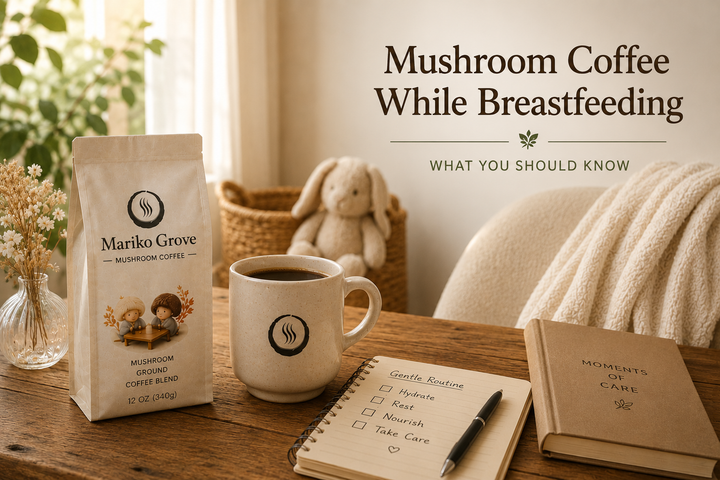
Can You Drink Mushroom Coffee While Breastfeeding? The Honest Answer Is: Ask Your Provider
By Chris Rea, COO of Mariko Grove · August 2026
Updated August 26, 2026
We sell mushroom coffee for a living, so you might expect a reassuring answer here. You won't get one. Whether mushroom coffee is safe while breastfeeding is a question for your doctor or a lactation consultant, not for a coffee company, and we're not going to tell you it's fine.
We already cover this briefly in our post on mushroom coffee during pregnancy, which touches breastfeeding in a couple of paragraphs. This post goes deeper, because breastfeeding raises its own, different questions: how much caffeine actually crosses into milk, what the federal guidance sets as a ceiling for a nursing parent specifically, and how fast caffeine moves through both the milk and the baby. None of that changes the bottom line. It just gives you more to bring to the appointment.
Mushroom Coffee Is Still Coffee
The word "mushroom" makes some people assume the coffee part is diluted or somehow gentler. Sometimes a brand does blend theirs to be lower in caffeine. Ours is not one of them. Mariko Grove is real Arabica coffee with measured amounts of Lion's Mane and Chaga extract added, and the caffeine content is comparable to a standard cup of coffee. The exact amount varies with how you brew it, which is why we say "comparable" rather than quoting a milligram figure.
So the starting point while breastfeeding is the same one you'd apply to any coffee: the caffeine counts. Our live FAQ page and our mushrooms page both say the same thing: if you're pregnant or breastfeeding, we recommend avoiding functional mushroom products until there's more safety data, and talking to your doctor.
What the CDC Says About Caffeine and Breastfeeding
According to the Centers for Disease Control and Prevention, caffeine passes from a breastfeeding mother to her infant in small amounts through breast milk, and this usually does not adversely affect the infant when the mother consumes low to moderate amounts. The CDC defines a low to moderate amount as about 300 milligrams or less per day, roughly two to three cups of coffee.
The CDC also notes the other end of the range: irritability, poor sleeping patterns, fussiness, and jitteriness have been reported in infants of mothers with very high caffeine intakes, which it defines as about 10 cups of coffee or more a day. And it flags one group specifically: preterm and younger newborn infants break down caffeine more slowly, so mothers of these infants might consider consuming even less.
That 300 milligram figure is caffeine guidance only. It tells you nothing about the mushroom extracts, which is a separate and, in lactation, still unresolved question we get to below.
How Much Caffeine Is in Common Drinks?
For context, here is roughly what different drinks contain, using the FDA's published ranges. Keep the CDC's 300 mg breastfeeding guidance in mind as you read the right-hand column.
| Drink | Typical caffeine | Against the CDC breastfeeding guidance (300 mg/day or less) |
|---|---|---|
| Brewed coffee (8 oz) | 80-100 mg | About a third of the daily guidance in one cup |
| Mariko Grove mushroom coffee (8 oz) | Comparable to a standard cup; varies by brew | Treat it exactly like regular coffee for the caffeine math |
| Espresso (1 oz shot) | ~63 mg | About five shots reach the guidance |
| Black or green tea (8 oz) | 30-50 mg | Six to ten cups reach the guidance |
| Energy drink (8 oz) | 40-250 mg | A single can may approach or exceed the daily guidance on its own |
| Caffeinated soda (12 oz) | 30-40 mg | Eight or more cans reach the guidance |
| Decaf coffee (8 oz) | 2-15 mg | Low, but not zero |
Caffeine figures are the FDA's published ranges; individual products vary, so check labels. The CDC also names chocolate as a common dietary source of caffeine worth remembering when you're adding up a day's total. This table covers the caffeine side of the question only. It says nothing about the mushroom extracts, which we address separately below.
The Timing Question: How Fast Does Caffeine Move Through Breast Milk?
This is the question we hear most often, so here is what the research actually shows, laid out as information rather than a schedule to follow.
According to LactMed, the National Institutes of Health's drugs and lactation database, caffeine appears in breast milk rapidly after a mother drinks it, with levels typically peaking about one hour after the dose (individual studies have found peaks anywhere from about one to two hours out). From that peak, caffeine clears from the milk itself with a half-life that different small studies have measured at roughly 4 to 7 hours.
That half-life describes the milk, not the baby. Once your infant takes in caffeine, their own body clears it far more slowly than an adult's does, especially in the newborn period. Thomas Hale's Medications and Mother's Milk, a reference widely used by lactation professionals, puts caffeine's half-life at about 97.5 hours in a newborn, 14 hours in a baby 3 to 5 months old, and 2.6 hours in a baby older than 6 months, compared with roughly 4.9 hours in an adult. LactMed independently confirms the shape of that pattern, noting that caffeine clearance is very low in preterm and newborn infants and reaches adult-like values by 3 to 5 months of age.
We are not turning any of that into a recommended gap between a cup of coffee and a feeding. What a given exposure means for your specific baby, especially if they're premature or very young, depends on your nursing pattern and your baby's health, and that's exactly the kind of question a lactation consultant or pediatrician is positioned to help you work through. We're giving you the sourced numbers, not a schedule.
Why the Pregnancy and Breastfeeding Numbers Differ
If you read our pregnancy post, you'll notice the caffeine ceiling there is different: ACOG advises less than 200 mg a day during pregnancy, while the CDC's breastfeeding guidance runs higher, at 300 mg or less. That's not because breastfeeding is treated as inherently safer. It comes down to physiology.
LactMed notes that caffeine's half-life in a pregnant woman's own body runs considerably longer than usual, particularly later in pregnancy, and returns to a non-pregnant rate within roughly the first week after birth. Once a mother's body is clearing caffeine at its ordinary rate again, the guidance shifts from the pregnancy ceiling to the breastfeeding one.
That shift is about the mother's own caffeine clearance. It has nothing to do with the mushroom extracts, which carry the identical "not studied" status in lactation that they carry in pregnancy. A higher caffeine ceiling after birth doesn't change our answer on Lion's Mane and Chaga at all.
The Mushrooms Still Haven't Been Studied in Lactation
Caffeine you can at least measure and budget against a published number. The functional mushrooms are different, because the honest state of the evidence is that we don't have one.
The research on Lion's Mane and Chaga, the two mushrooms in every Mariko Grove blend, has been conducted in general adult populations, and it's still early-stage even there. There are no established studies of these extracts in lactation, no established safe amounts for a nursing parent, and no data on whether or how their compounds pass into breast milk. When a brand implies its mushroom blend is fine while nursing, ask what that claim is standing on. We're not aware of anything it could stand on.
This lines up with the National Center for Complementary and Integrative Health's general guidance on supplements: as NCCIH puts it, many dietary supplements have not been tested in pregnant women, nursing mothers, or children. Functional mushroom extracts sit squarely in that category. You can read more about what's in our blend on our mushrooms page, written for the adults these products are made for.
What "Not Studied" Actually Means
It's worth being precise, because "not studied" is not the same as "known to be harmful."
Absence of evidence is not evidence of harm. There is no finding that Lion's Mane or Chaga causes a problem for a nursing infant. But there is also no finding that they're safe in lactation, and that gap is exactly why we don't fill it with reassurance. The reasonable posture with an unstudied botanical during breastfeeding is caution by default, which is the posture we take: hold off, and ask.
The Practical Step: Bring the Label and COA to Your Provider or Lactation Consultant
Here's where a transparent brand should actually be useful. The right way to make this decision is to sit down with your doctor, a board-certified lactation consultant, or a pharmacist, and the best thing you can bring them is exact ingredient information rather than a marketing claim.
That's part of why we publish third-party lab results for our coffee base and keep our labeling specific rather than vague. Our lab reports page and our mushrooms page lay out what's in the blend and what the coffee base is tested for, so whoever you're talking to is deciding from facts rather than guesswork. Both product pages, ground mushroom coffee and instant mushroom coffee, carry the full ingredient list, so you can walk in with the exact label rather than a description of it. A lactation consultant in particular is used to weighing exactly this kind of ingredient question against your specific nursing pattern and your baby's age, which is more than a label alone can tell you.
Keeping the Ritual While You Wait
If mushroom coffee is off the table for now, the part worth keeping is the ritual itself: the warm mug and the few quiet minutes before the day starts. That doesn't have to pause.
Many breastfeeding parents keep a warm drink in the rotation using lower-caffeine or caffeine-free options, and plenty of decaf and non-coffee choices exist. One caution: some herbal teas carry their own considerations during lactation, so treat any specific drink the same way you'd treat our coffee and run it by your provider or lactation consultant first. And the mushroom question isn't closed forever, it's just deferred: whether functional mushrooms fit back into your routine once you've stopped nursing is, again, a decision to make with your doctor when the time comes.
Frequently Asked Questions
Can you drink mushroom coffee while breastfeeding?
That's a question for your doctor or a lactation consultant, and we don't clear our coffee for breastfeeding. Mushroom coffee contains real caffeine (ours is comparable to a regular cup), which the CDC's guidance keeps to 300 mg or less a day for nursing mothers, and the functional mushrooms in it, Lion's Mane and Chaga, have not been studied in lactation at all. Bring the ingredient information to your provider and decide together.
Does caffeine actually reach breast milk?
Yes. According to the CDC, caffeine passes from mother to infant in small amounts through breast milk, and this usually does not adversely affect the infant at low to moderate maternal intakes of about 300 mg or less a day. LactMed adds that caffeine appears in milk rapidly, typically peaking about an hour after a dose, and clears from the milk with a half-life researchers have measured at roughly 4 to 7 hours in different studies.
If a mushroom coffee is lower in caffeine, is that automatically safe while nursing?
No, and Mariko Grove specifically isn't a low-caffeine blend to begin with; ours is comparable to a standard cup, so the caffeine math doesn't change. But even for a genuinely lower-caffeine mushroom coffee, caffeine is only one of the two questions. The mushroom extracts carry the same unstudied status in lactation regardless of how much caffeine is in the cup, so a lower-caffeine product still isn't something we'd clear for breastfeeding. Either way, that's a call for your provider or lactation consultant.
Are Lion's Mane and Chaga studied in lactation?
No. There are no established studies of Lion's Mane or Chaga extracts in lactation, no established safe amounts for a nursing parent, and no data on whether or how their compounds pass into breast milk. The National Center for Complementary and Integrative Health notes that many dietary supplements have not been tested in nursing mothers, and functional mushroom extracts fall into that gap, which is why we recommend holding off and asking your provider.
Why is the breastfeeding caffeine guidance higher than the pregnancy guidance?
It comes down to the mother's own physiology, not a difference in how safe the product is. ACOG advises less than 200 mg a day in pregnancy, while the CDC's breastfeeding guidance allows up to 300 mg. LactMed notes that caffeine clears more slowly during pregnancy, especially later on, and returns to its normal rate within about the first week after birth, which is what moves the ceiling. It doesn't change our answer on the mushroom extracts, which remain unstudied in both pregnancy and lactation.
The Bottom Line
Can you drink mushroom coffee while breastfeeding? We won't say yes, because we can't. Ours carries the caffeine of a regular cup, which the CDC's breastfeeding guidance caps at 300 mg or less a day, plus mushroom extracts that simply haven't been studied in lactation. The honest answer, and the one a careful provider would give, is to hold off until you've talked it through with your doctor or a lactation consultant, ingredient label in hand.
If you'd like to have that conversation from real information, our lab reports and our mushrooms pages lay out exactly what's in the blend, and if you get the go-ahead, both blends live together in our mushroom coffee collection, ingredient lists and all. If you're earlier in the process, our companion guide covers mushroom coffee and pregnancy, and if you're weighing it for the rest of the household, we also cover whether kids can drink mushroom coffee with the same honest posture. More answers live on our FAQ page.
About the Author
Chris Rea is the COO of Mariko Grove, overseeing operations, sourcing, and shipping logistics. He ensures every batch of mushroom coffee is handled with care from warehouse to doorstep.
Medical Disclaimer: This article is provided for informational purposes only and is not medical advice. Always consult your doctor, a board-certified lactation consultant, or another healthcare provider about caffeine, dietary supplements, and functional mushroom products while breastfeeding. Statements regarding mushroom coffee products have not been evaluated by the U.S. Food and Drug Administration. This product is not intended to diagnose, treat, cure, or prevent any disease.